



Enterprise Content Delivery Network
2025-12-12 14:55Enterprise Content Delivery Network (ECDN), evolved from the original Dynamic Site Accelerator (DSA), leverages Tencent's globally deployed node infrastructure and over a decade of technical expertise from the QQ platform to provide highly reliable, low-latency, one-stop acceleration services for purely dynamic websites and hybrid dynamic-static websites. ECDN integrates static edge caching with dynamic origin path optimization, combining proprietary optimal-link algorithms and protocol-layer optimization technologies. It supports intelligent and precise scheduling, optimal routing, full-protocol access, reliable disaster recovery, and secure transmission—all with a single click, enabling immediate full-site acceleration and safeguarding your business! As a mature core enterprise-level acceleration product, the Enterprise Content Delivery Network leverages Tencent Cloud's global 2,800+ edge nodes and BGP Anycast architecture to achieve nearby user access. Dynamic Content Acceleration optimizes transmission paths for dynamic requests (e.g., PHP, JSP) to reduce interactive latency. Protocol Optimization supports cutting-edge protocols such as HTTP/2 and QUIC, improving data transmission efficiency and connection reuse. Dynamic and Static Convergence intelligently distinguishes between static and dynamic content, enabling integrated processing of "static caching + dynamic acceleration." Intelligent Routing dynamically monitors network status and switches to the optimal transmission path in real-time, avoiding congestion and failures. Whether for high-concurrency transactions on e-commerce platforms, real-time interactions in financial systems, or hybrid content access for corporate websites, the Enterprise Content Delivery Network serves as the core support for enterprise business transmission, thanks to the flexibility of Dynamic Content Acceleration, the efficiency of Protocol Optimization, the adaptability of Dynamic and Static Convergence, and the stability of Intelligent Routing. Furthermore, the deep synergy between Intelligent Routing and Dynamic and Static Convergence significantly enhances ECDN's acceleration efficiency and scenario adaptability.
Frequently Asked Questions
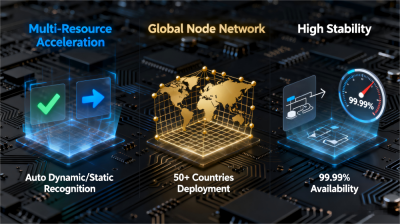
Q: As the core transmission engine, how does Intelligent Routing collaborate with Protocol Optimization and Dynamic and Static Convergence to support the core needs of the Enterprise Content Delivery Network and Dynamic Content Acceleration? Where are its technical advantages reflected?
A: With "real-time perception + dynamic scheduling" as its core, Intelligent Routing provides foundational support for the two core capabilities, solidifying the service foundation of ECDN. Firstly, by monitoring the status of global network links in real-time, it matches the optimal transmission path for Dynamic Content Acceleration. Combined with the deep adaptation of Protocol Optimization to protocols such as HTTP/2 and QUIC, it reduces connection establishment time and data transmission loss, significantly improving the response speed of dynamic requests. Secondly, it empowers Dynamic and Static Convergence to achieve efficient adaptation across all scenarios. Intelligent Routing dynamically adjusts transmission strategies based on content types: static content is quickly distributed through edge node caching, while dynamic content reaches the origin server via optimized paths. Meanwhile, Protocol Optimization ensures the compatibility and efficiency of transmitting both static and dynamic content, enabling the Enterprise Content Delivery Network to achieve "integrated static and dynamic acceleration seamlessly." The technical advantages are reflected in two aspects: First, "low latency + high stability"—the dynamic scheduling of Intelligent Routing avoids link congestion, while Protocol Optimization enhances transmission efficiency, jointly supporting the real-time requirements of Dynamic Content Acceleration. Second, "full-scenario coverage + easy adaptation"—it adapts to various business scenarios through Dynamic and Static Convergence and, through the synergy of Intelligent Routing and Protocol Optimization, enables the Enterprise Content Delivery Network to achieve optimal acceleration effects without complex configurations.
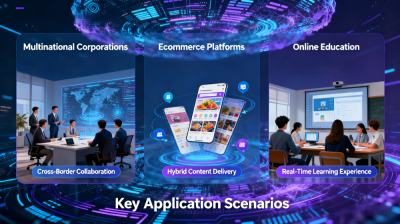
Q: What is the core collaborative value of Dynamic Content Acceleration and Dynamic and Static Convergence? How can the Enterprise Content Delivery Network and Protocol Optimization be leveraged to strengthen ECDN's competitiveness?
A: Their core collaborative value lies in "full-scenario coverage + efficiency multiplication," addressing the pain points of traditional acceleration such as "weak support for dynamic scenarios and poor experience due to static-dynamic separation." Dynamic Content Acceleration focuses on low-latency transmission of complex dynamic requests, solving slow response issues in interactive businesses. Dynamic and Static Convergence achieves integrated acceleration for both static and dynamic content, eliminating the hassle of switching between multiple tools. Together, they elevate ECDN from a "single acceleration tool" to a "full-site integrated acceleration solution." Their synergy with the Enterprise Content Delivery Network and Protocol Optimization significantly enhances competitiveness. The Enterprise Content Delivery Network provides global edge nodes and backbone network support for both: Dynamic Content Acceleration can leverage edge nodes for nearby request forwarding, while Dynamic and Static Convergence intelligently distinguishes content types through nodes. Protocol Optimization provides transport-layer performance guarantees for Dynamic Content Acceleration, reducing latency and packet loss, while making the transmission process of Dynamic and Static Convergence more efficient—for example, using QUIC's 0-RTT handshake feature to improve the initial access speed for both static and dynamic content. This combination of "full-scenario acceleration + integrated adaptation + global coverage + transmission optimization" gives ECDN stronger market competitiveness.
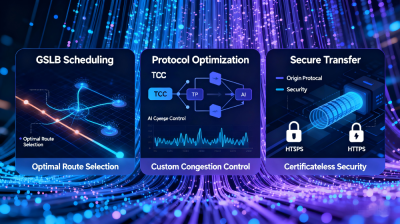
Q: How does Protocol Optimization address the pain points of transmission efficiency in the Enterprise Content Delivery Network? What gains does its synergy with ECDN and the Enterprise Content Delivery Network bring to Intelligent Routing and Dynamic Content Acceleration?
A: The core value of Protocol Optimization lies in "enhanced transmission efficiency + improved compatibility," solving traditional acceleration network pain points such as "outdated protocols and high transmission loss." Through advanced protocols like HTTP/2 and QUIC, it optimizes connection management, data compression, and congestion control, significantly reducing transmission latency and bandwidth consumption. Its synergy with the two core capabilities brings significant gains to scenario-based services. Collaborating with ECDN and the Enterprise Content Delivery Network, Protocol Optimization can be deeply integrated into the scheduling logic of Intelligent Routing, dynamically selecting the optimal protocol based on link status to improve the transmission efficiency of Dynamic Content Acceleration. For Intelligent Routing, the anti-packet-loss and anti-jitter characteristics of Protocol Optimization enhance link transmission stability, ensuring low latency for Dynamic Content Acceleration even in complex network environments. Meanwhile, the connection reuse capability of Protocol Optimization reduces the consumption of link resources. For Dynamic Content Acceleration, Protocol Optimization shortens request response times—for example, the multiplexing feature of HTTP/2 avoids connection queuing. Combined with the optimal path selection of Intelligent Routing, the entire process from request initiation to response for dynamic requests becomes significantly more efficient, further strengthening the core advantages of the Enterprise Content Delivery Network. This synergy enhances the transmission stability of Intelligent Routing, accelerates the response speed of Dynamic Content Acceleration, and positions Tencent Cloud ECDN as the preferred solution for enterprise full-site acceleration.