

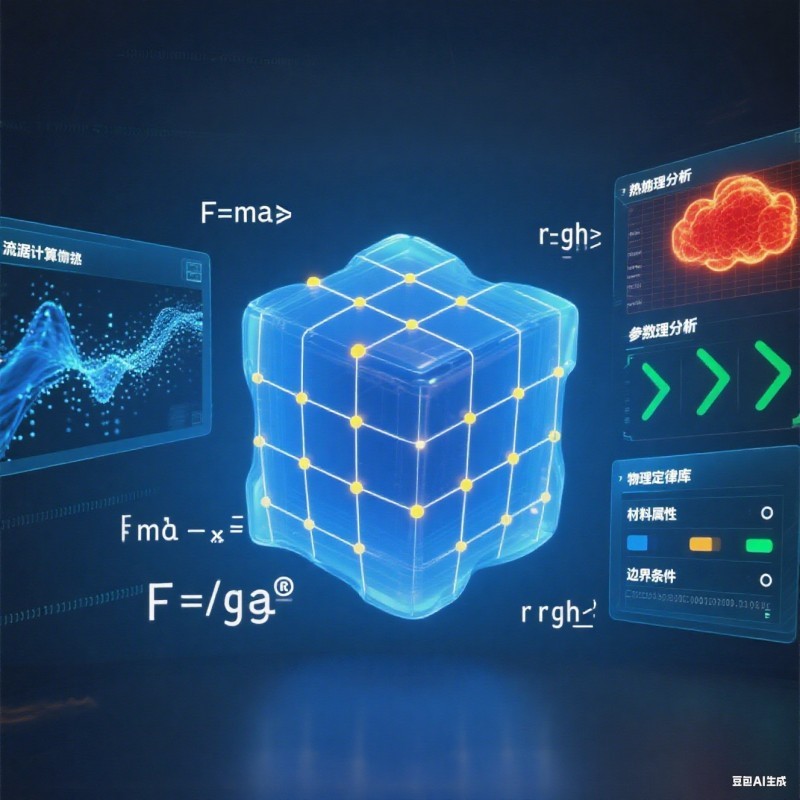

AI Physics Simulation Model
To address enterprise data scarcity, Gallop World IT develops "small-sample learning + domain adaptation" technologies centered on machine learning-based physical simulation. For data-limited enterprises, we enable deep learning physical simulation models through three layers: supplying compliant datasets, integrating physical mechanisms to reduce data dependency, and automating data collection via the platform. For specialized scenarios like niche chemical synthesis, dedicated teams build custom model frameworks. These models are encapsulated in a low-code industrial AI platform, allowing non-technical staff to operate them effortlessly.
- Information
In the context of deep integration of AI and industry, physics simulation faces industry pain points such as “low computational efficiency, difficult scenario adaptation, and high data dependency.” Relying on “algorithm innovation + industry expertise,” Gallop World IT has developed mature AI-Powered Physics Simulation solutions covering smart manufacturing, new energy, aerospace, and other fields. By leveraging core technologies including AI-Powered Physics Simulation, Machine Learning Physics Simulation, and Deep Learning Physics Simulation Model, the company has built an efficient and accurate Engineering AI Physics Simulation system. With strong technical capabilities and scene-based implementation, it serves as a key partner in enterprise digital transformation.
The company has broken through traditional simulation efficiency bottlenecks by creating a millisecond-response AI simulation engine. Through “physical mechanism modeling + deep learning transfer,” it uses classical physics formulas to establish a foundational framework combined with mass data training for the Deep Learning Physics Simulation Model. For example, in new energy battery thermal runaway simulation, traditional 24-hour processes are shortened to 500 milliseconds with an error rate of <3%. Scenarios such as fatigue life prediction of automotive components and aerospace engine airflow analysis achieve 100-1000x efficiency improvements, helping leading companies compress testing cycles and reduce R&D costs.
At the same time, Gallop World IT focuses on tackling low data availability and poor model reusability by creating industry solutions with “low data dependency + cross-scene migration,” further strengthening the Industrial AI Physics Simulation Platform and Engineering AI Physics Simulation services. The company has developed “small-sample learning + domain adaptation” technology, incorporating physical prior knowledge to minimize data requirements. For instance, in machining process simulation, only 50 data sets are needed to achieve 92% accuracy. Cross-scenario transfer modules are also developed to significantly shorten model adaptation cycles.

Frequently Asked Questions
Q: Our company has little experience in physics simulation and limited data accumulation. Can we directly use Gallop World IT’s Deep Learning Physics Simulation Model and Industrial AI Physics Simulation Platform?
A: Absolutely. For enterprises with scarce data, we adopt a “three-layer empowerment” model based on AI-Powered Physics Simulation to tackle data dependency: First, we provide general industry baseline datasets (e.g., material parameter libraries and typical condition simulation data) as initial support for training the Deep Learning Physics Simulation Model, all sourced from years of industry experience and desensitized for compliance. Second, using a “physics-first” modeling approach, we integrate established physical formulas and process standards into the model, greatly reducing reliance on real data. For example, in chemical reactor temperature field simulation, only basic parameters from the client are needed before combining with the Engineering AI Physics Simulation thermodynamic model for rapid system setup. Finally, we offer a lightweight “use-while-training” tool where the Industrial AI Physics Simulation Platform automatically collects real-time production data and optimizes the model through incremental learning. Typically, within three months, accuracy improves from 85% to over 95%.

Q: Our production scenario is highly specific (e.g., synthesis of niche chemical products). Can Gallop World IT’s Machine Learning Physics Simulation and Engineering AI Physics Simulation solutions adapt to such non-standard scenarios?
A: Yes. Our core strength lies in “customized modeling capabilities.” For specialized scenarios, using AI-Powered Physics Simulation technology, we employ a “deep scenario analysis + modular customization” process: First, a dedicated team of industry experts and AI algorithm engineers conducts on-site analysis of core physical processes, key factors, and business objectives. Second, based on this analysis, a customized physical model framework is built. For example, in niche chemical synthesis scenarios, we optimize reaction kinetic equations and material diffusion models to ensure the Machine Learning Physics Simulation logic aligns with actual processes. Third, the model is trained using the enterprise’s limited data and small-sample learning techniques, refined through a closed loop of “simulation prediction – on-site validation – parameter iteration.”

Q: After introducing AI-Powered Physics Simulation models and the Industrial AI Physics Simulation Platform, will employees need professional AI or simulation skills? How is ongoing technical support provided?
A: No professional technical skills are required, and we offer full-lifecycle support to ensure efficient system operation. On the operational level, we encapsulate the Deep Learning Physics Simulation Model into a “low-code visual platform” with a business-friendly interface. For instance, in machining simulation, employees only need to select parameters and click “Start Simulation” to receive a report including defect predictions and optimization suggestions. Custom “one-click simulation” templates are also available, significantly reducing the barrier to operation via the Industrial AI Physics Simulation Platform. For support, we have a “three-tier guarantee system”: Tier 1 – A dedicated customer success manager responds to requests within two hours; Tier 2 – The technical team provides remote or on-site support within 24 hours; Tier 3 – Quarterly optimization updates for the Machine Learning Physics Simulation model. Additionally, we provide both online and offline training. To date, all customer systems maintain 100% usage rates and over 98% satisfaction with issue resolution.