



Elastic Network Interface
2025-12-11 16:15Elastic Network Interface (ENI) is an elastic network interface bound to cloud hosts within a private network and can be freely migrated between multiple cloud hosts. You can bind multiple Elastic Network Interfaces (ENIs) to a cloud host to implement high-availability network solutions. You can also bind multiple private IP addresses to an Elastic Network Interface (ENI) to achieve a single-host multi-IP deployment. As a mature core cloud networking component, an Elastic Network Interface (ENI) can be bound to cloud hosts within a private network and supports free migration between cloud hosts in the same Availability Zone. Multi-IP Deployment allows a single Elastic Network Interface (ENI) to be bound to multiple private IP addresses and can be associated with independent Elastic Public IPs, enabling deployment of multiple services/ports on a single host. Security Group Policies can be configured independently for different Elastic Network Interfaces (ENIs), enabling precise control over internal and external communication permissions. Independent Routing and Forwarding supports setting differentiated routing policies for Elastic Network Interfaces (ENIs) belonging to different subnets, achieving traffic isolation and directional forwarding. Multi-NIC Configuration allows a single cloud host to bind multiple Elastic Network Interfaces (ENIs), adapting to complex scenarios such as isolating internal, external, and management networks. Whether for high-availability deployment of critical services, multi-scenario network isolation requirements, or flexible expansion of multiple services on a single host, Elastic Network Interface (ENI) can leverage the flexibility of Multi-IP Deployment, the reliability of Security Group Policies, the controllability of Independent Routing and Forwarding, and the adaptability of Multi-NIC Configuration to become the core support for optimizing enterprise cloud network architectures. Furthermore, the deep synergy between Multi-NIC Configuration and Independent Routing and Forwarding significantly expands the scenario coverage and network efficiency of Elastic Network Interface (ENI).
Frequently Asked Questions
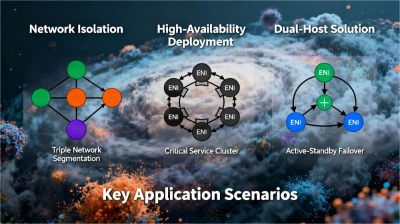
Q: As a core deployment capability, how does Multi-NIC Configuration synergize with Multi-IP Deployment and Security Group Policies to support the core needs of Elastic Network Interface (ENI) and Independent Routing and Forwarding? Where are its technical advantages reflected?
A: Centered on "Multi-interface Parallel Operation + Layered Deployment," Multi-NIC Configuration provides architectural support for two core capabilities, solidifying the service foundation of Elastic Network Interface (ENI). Firstly, by binding multiple Elastic Network Interfaces (ENIs) to a single cloud host, each network interface can be independently configured with Multi-IP Deployment and Security Group Policies. For example, an external-facing ENI can be bound to a public IP with specific service ports opened, while an internal ENI is configured only with private IPs and restricted to internal communication. This works in conjunction with Independent Routing and Forwarding to achieve directional forwarding and isolation of traffic for different network interfaces. Secondly, it empowers Independent Routing and Forwarding to achieve more granular traffic control. Different Elastic Network Interfaces (ENIs) can belong to different subnets, with each subnet's traffic directed to different gateways (e.g., NAT Gateway, VPN Gateway) through independent routing and forwarding policies. Simultaneously, Multi-IP Deployment allows a single network interface to host multiple services. Coupled with the differentiated protection of Security Group Policies, this meets the network demands of complex businesses. Technical advantages are evident in two aspects: First, "Flexible Expansion + Thorough Isolation" – Multi-NIC Configuration allows Elastic Network Interface (ENI) to adapt to complex scenarios like three-network isolation, while Multi-IP Deployment enhances the service hosting capacity of a single interface, and Security Group Policies ensure the independent security of each interface. Second, "High Availability + Easy O&M" – it supports migrating Elastic Network Interfaces (ENIs) across hosts. Combined with the redundant design of Multi-NIC Configuration, this improves business disaster recovery capabilities. Meanwhile, Independent Routing and Forwarding simplifies traffic management and reduces operational costs.
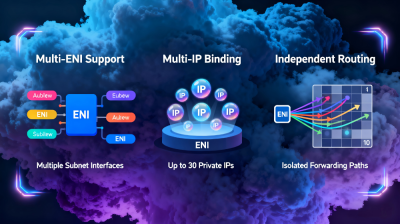
Q: What is the core synergistic value between Security Group Policies and Independent Routing and Forwarding? How can Multi-IP Deployment and Multi-NIC Configuration be leveraged to strengthen the competitiveness of Elastic Network Interface (ENI)?
A: Their core synergistic value lies in the dual guarantee of "Security Protection + Traffic Control," addressing the cloud networking pain points of "singular protection and chaotic traffic." Security Group Policies focus on port and instance-level access control, achieving precise management of "who can access." Independent Routing and Forwarding focuses on the path planning of traffic, achieving directional scheduling of "where traffic goes." Their combination elevates the network control of Elastic Network Interface (ENI) from "passive protection" to "active control + precise protection." Their synergy with Multi-IP Deployment and Multi-NIC Configuration significantly enhances the competitiveness of Elastic Network Interface (ENI): Multi-NIC Configuration provides the vehicle for Security Group Policies and Independent Routing and Forwarding. Different network interfaces can be configured with different security policies and routing rules, enabling layered protection and directional forwarding. Multi-IP Deployment allows a single network interface to host multiple services. Working with Security Group Policies, it achieves differentiated protection for multiple services on a single interface, while ensuring traffic from different services does not interfere through Independent Routing and Forwarding. This combination of "Security Protection + Traffic Control + Flexible Expansion + Layered Deployment" enables Elastic Network Interface (ENI) to both meet the network isolation needs of complex businesses and ensure service security and flexibility, giving it stronger market competitiveness.
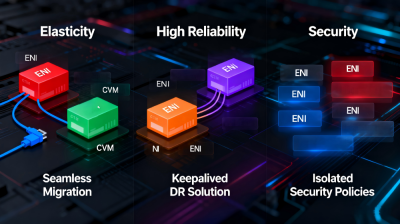
Q: How does Multi-IP Deployment address the pain points of expansion and service deployment in cloud-based businesses? What benefits does its synergy with Elastic Network Interface (ENI) and Multi-NIC Configuration bring to Security Group Policies and Independent Routing and Forwarding?
A: The core value of Multi-IP Deployment lies in "Multiple Services per Interface + Flexible Expansion," solving the traditional network interface pain points of "scarce IP resources and complex multi-service deployment on a single host." By binding multiple private IP addresses to a single Elastic Network Interface (ENI), it enables deployment of multiple independent services on a single cloud host. Each IP can also be associated with an Elastic Public IP, supporting the external exposure of multiple ports. Its synergy with the two core components brings significant gains to scenario-specific capabilities: Working with Elastic Network Interface (ENI) and Multi-NIC Configuration, Multi-IP Deployment allows each network interface to host more services. Combined with the layered deployment of Multi-NIC Configuration, it enables parallel services for multiple scenarios like "External Services + Internal Management + Data Transfer." Simultaneously, the migration capability of Elastic Network Interface (ENI) allows Multi-IP configurations to be quickly migrated along with the interface, improving disaster recovery efficiency. For Security Group Policies, Multi-IP Deployment can be precisely bound with them, configuring independent protection rules for the service corresponding to each IP, enhancing protection precision. For Independent Routing and Forwarding, traffic from Multi-IP Deployment can be directionally scheduled through Independent Routing and Forwarding. For example, traffic from different service IPs can be directed to different gateways, optimizing access paths while preventing a single routing failure from affecting all services. This synergy makes the protection of Security Group Policies more refined, the control of Independent Routing and Forwarding more flexible, and establishes Elastic Network Interface (ENI) as a core network component supporting rapid business expansion.