


Hyper Computing Cluster
2025-12-05 17:19Tencent Cloud High Performance Computing Cluster (HCC) is a Cloud HPC Cluster with high-performance cloud servers as its core nodes. Relying on a unique HPC Cluster Architecture, it achieves computation with no virtualization overhead and full retention of server characteristics, while combining the convenient operations of a Managed HPC Cluster with the formidable computing power of a GPU HPC Cluster. It provides high-bandwidth, low-latency parallel computing support for scenarios such as large-scale AI training, material simulation, and industrial simulation CAE.
As a benchmark product among Cloud HPC Clusters, the High Performance Computing Cluster implements node interconnection via a RoCEv2 RDMA network, achieving a transmission latency as low as 2us. Paired with high-performance storage solutions (supporting elastic scaling of COS/CFS and local NVMe SSD hard drives), it perfectly adapts to heavy I/O and high-concurrency computing demands. The features of a Managed HPC Cluster free users from concerns about underlying resource operations, allowing them to focus on core business innovation. The heterogeneous hardware acceleration capability of the GPU HPC Cluster further enhances the cost-effectiveness of the High Performance Computing Cluster, making it excel in compute-intensive scenarios like AI training. Whether building a Cloud HPC Cluster to handle industrial simulation tasks or deploying a GPU HPC Cluster to advance large-scale AI model training, the High Performance Computing Cluster can leverage its optimized HPC Cluster Architecture and the efficient advantages of a Managed HPC Cluster, serving as the core infrastructure for enterprise-level high-performance computing.
Frequently Asked Questions
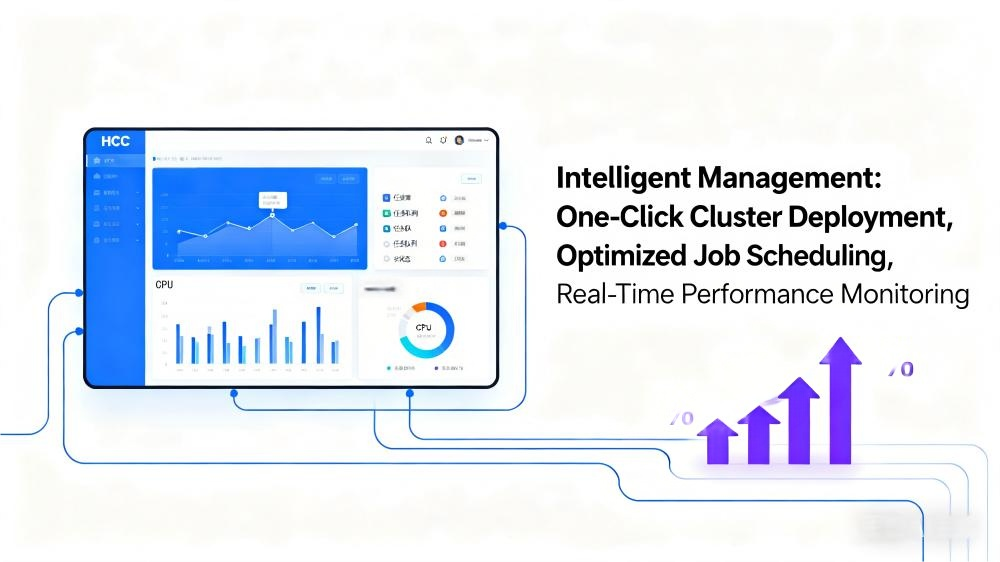
Q: As the core form of Cloud HPC Clusters, how does the High Performance Computing Cluster adapt to complex high-performance computing needs through the characteristics of GPU HPC Clusters and Managed HPC Clusters?
A: The High Performance Computing Cluster is based on an advanced HPC Cluster Architecture, achieving deep integration between the flexible elasticity of Cloud HPC Clusters and the computing power advantages of GPU HPC Clusters. The GPU HPC Cluster supports the latest generation of GPU instances and heterogeneous hardware acceleration, significantly improving computational efficiency in scenarios like large-scale AI training and material simulation. The characteristics of the Managed HPC Cluster fully handle tasks like resource scheduling and operational management, freeing users from investing in underlying maintenance costs. Simultaneously, the High Performance Computing Cluster's RDMA high-speed network and high-performance storage solutions further enhance the parallel computing capabilities of the Cloud HPC Cluster. Whether handling compute-intensive tasks borne by the GPU HPC Cluster or complex workflow computing supported by the Managed HPC Cluster, the High Performance Computing Cluster, through its optimized HPC Cluster Architecture, ensures low-latency, high-stability operational results.

Q: What are the core advantages of a Managed HPC Cluster? How does it synergize with the HPC Cluster Architecture to improve the user experience of Cloud HPC Clusters?
A: The core advantage of a Managed HPC Cluster lies in being "worry-free and efficient," requiring no user attention to underlying operations like server deployment or network configuration, allowing focus solely on the business computation itself. This characteristic forms a perfect synergy with the "elastic high performance" of the HPC Cluster Architecture. The HPC Cluster Architecture supports fully automated provisioning and elastic scaling, making resource scheduling for the Managed HPC Cluster more flexible, allowing dynamic adjustment of node count based on task scale. Simultaneously, the RDMA high-speed network and high-performance storage within this architecture provide solid performance support for the Cloud HPC Cluster. This ensures that the Managed HPC Cluster maintains both convenience and computational power/speed when processing large-scale parallel computing tasks. Furthermore, the heterogeneous acceleration capability of the GPU HPC Cluster is integrated into the service system of the Managed HPC Cluster, giving the Cloud HPC Cluster greater cost-effectiveness in scenarios like AI training, fully reflecting the comprehensive advantages of the High Performance Computing Cluster.
Q: Why can a GPU HPC Cluster become the core configuration of a High Performance Computing Cluster? What key role does its adaptation with the HPC Cluster Architecture play in enhancing the performance of Cloud HPC Clusters?
A: The GPU HPC Cluster can become the core configuration of the High Performance Computing Cluster because it possesses formidable parallel computing capabilities, precisely matching the needs of compute-intensive scenarios like large-scale AI training and industrial simulation. This advantage is maximized through the HPC Cluster Architecture. The HPC Cluster Architecture employs RDMA low-latency network interconnection, with latency as low as 2us, making multi-node collaborative computing within the GPU HPC Cluster more efficient and achieving near-linear computational speedup ratios. Simultaneously, the elastic scaling feature supported by the architecture allows the GPU HPC Cluster to dynamically adjust computing power based on task demands, avoiding resource waste. As a core component of the Cloud HPC Cluster, the deep adaptation between the GPU HPC Cluster and the HPC Cluster Architecture not only improves single-node computational efficiency but also optimizes the resource utilization of the entire Managed HPC Cluster. This enables the High Performance Computing Cluster to maintain robust computing power while offering a flexible and convenient user experience in complex high-performance computing scenarios.